
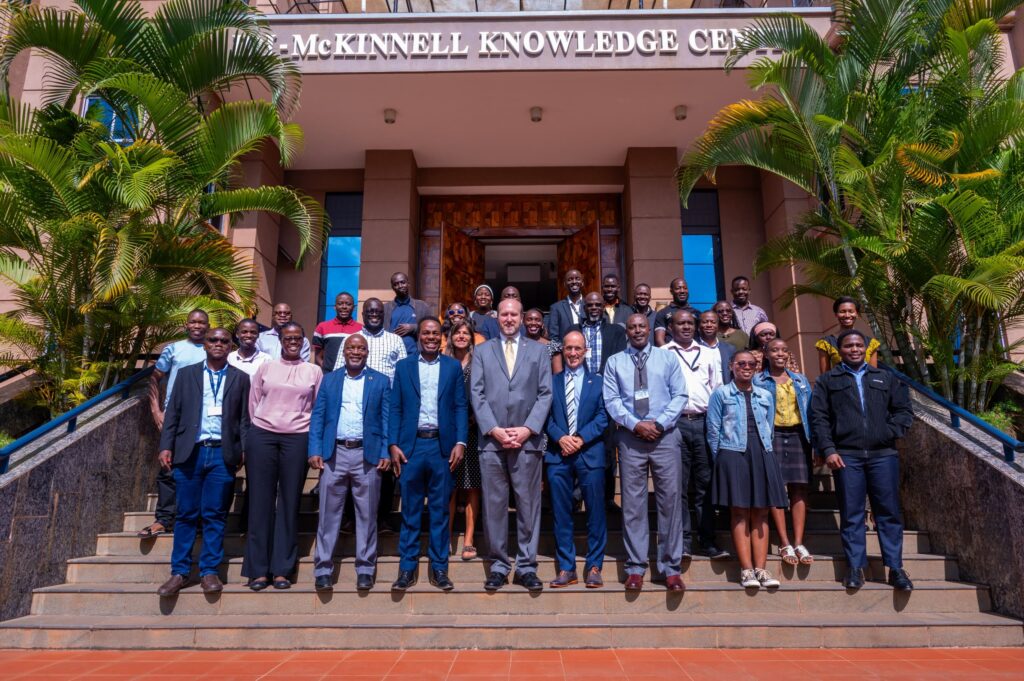
U.S. Ambassador William W. Popp and ACE Director Daudi Jjingo at the launch event, May 29, 2025, at the Infectious Diseases Institute, Makerere University.
On May 29, 2025, the African Center of Excellence in Bioinformatics and Data Intensive Sciences (ACE-Uganda) launched its upgraded High-Performance Computing (HPC) Cluster at the Infectious Diseases Institute (IDI) of Makerere University in Kampala. This advanced 56-node platform—expanding from the original setup with 56 new nodes—delivers a five-fold boost in computational power, offering over 15,232 CPU and 5 terabytes of RAM. Hosted under the NIH/NIAID-facilitated ACE consortium, the event drew dignitaries like U.S. Ambassador William W. Popp, IDI Executive Director Dr. Andrew Kambugu, and ACE Director Dr. Daudi Jjingo, celebrating a strengthened U.S.-Uganda partnership for scientific innovation.
For researchers in bioinformatics or data-intensive sciences, HPC clusters are vital for processing massive datasets that outstrip standard computers. The system parallelizes tasks across nodes—each a mini-server with multiple CPUs—connected via high-speed InfiniBand for rapid data transfer. This supports workflows like genomic sequence alignment (e.g., via BWA-MEM), statistical modeling in R, or molecular dynamics with GROMACS. Pre-upgrade, ACE’s 13-node cluster handled basic tasks; now, with enhanced parallel CPU processing, it tackles terrabyte-scale data in hours, not weeks.

US Ambassador William W.Popp with Dr. Steve Reynolds and IDI’s Head of Strategic Planning and Development, Tom Kakaire lauching the upgraded High Performance Computing Cluster at ACE Uganda, Infectious Diseases Institute – Makerere University.
The upgrade directly addresses Africa’s health priorities. In antimicrobial resistance (AMR), where superbugs kill 1.27 million annually—disproportionately in low-resource regions—the cluster runs metagenomic pipelines to identify resistance genes in clinical or environmental samples. In human genomics, it powers variant calling with GATK on African cohorts, uncovering population-specific insights missing from Euro-centric databases like gnomAD. Cancer research benefits from phylogenetic tumor modeling, while AI applications include predictive epidemiology for outbreaks like Ebola. Paired with ACE’s VR lab, it enables immersive visualization—rendering 3D protein structures or genomic landscapes in virtual reality for collaborative analysis.
The launch blended ceremony and technical showcases. Ambassador Popp emphasized the donation from the University of Texas at Austin, facilitated by NIH/NIAID and the Foundation for the National Institutes of Health (FNIH): “This infrastructure empowers African-led solutions for global health challenges.” Dr. Kambugu added, “The cluster accelerates genomics and infectious disease research, fostering U.S.-Africa partnerships.” Dr. Jjingo outlined specs: nodes with Intel Xeon CPUs and NVMe SSDs for fast I/O, managed by a Slurm scheduler for efficient job queuing. Demos highlighted real-time polygenic risk score (PRS) calculations and AlphaFold protein predictions, showcasing integration with tools like Google Colab for hybrid workflows.
Access is user-friendly: researchers connect via SSH (e.g., ssh username@ace-hpc.mak.ac.ug), load modules for R/Bioconductor or Python/Anaconda, and submit jobs with Slurm scripts (sbatch job.sh) specifying CPU cores and time. The ACE HPC Wiki offers tutorials, from basic srun commands to parallel job optimization. Security includes encrypted SFTP transfers and role-based access, ensuring compliance with GDPR-equivalent standards for sensitive health data.
We extend gratitude to NIH/NIAID for coordination, the University of Texas at Austin for hardware, FNIH for private-sector links (e.g., Intel, Dell/EMC), and local partners like Makerere’s Colleges of Health and Computing Sciences. Building on the 2019 launch of ACE’s original 13 node cluster, this upgrade supports several pan-African projects. Since 2019, ACE has trained over 100 graduates, producing tools like the HEAL app for health workers and VR-based emergency simulations.
The launch fostered collaboration: alumni panels discussed AMR surveillance networks, while breakout sessions planned cross-border cancer genomics projects. Post-launch, job throughput has tripled, with 92% user satisfaction for reduced wait times in surveys.
For aspiring bioinformaticians, this cluster democratizes HPC access. African institution-affiliated researchers can apply via ACE’s portal for free accounts. Beginners should start with FASTQC for NGS data quality checks, then scale to GWAS or metagenomics. Tip: Use Nextflow for automated, parallelized pipelines across nodes. Cloud-burst integrations with AWS further extend capacity for peak loads.
ACE-Uganda’s mission—to drive sustainable health innovation—gains traction with this upgrade. As Africa confronts non-communicable diseases and pandemics, the cluster enables breakthroughs like AI-driven drug repurposing for tuberculosis. It’s more than compute power; it’s a foundation for African-led discovery. Join the movement at ace.ac.ug—your research future starts here.